For most households the choice between a Miele and a Thermador refrigerator comes down to layout, not quality. Thermador’s Freedom Collection gives you more column widths to combine, from an 18-inch freezer up to 36-inch fresh food and freezer columns, and its sealed-system warranty reaches the 12th year for parts. Miele’s MasterCool line matches it almost exactly on 30-inch capacity, publishes a quiet 40 dB(A) rating and uses model letters that tell you at a glance what each unit is. Either brand, set into a square cabinet and kept clean, makes a sound long-term choice.
What each brand actually sells
Thermador builds its built-in cold storage around Freedom, a modular family meant to stand alone or in a row. The narrowest piece is an 18-inch freezer; full-height fridge and freezer columns then come in 24, 30 and 36 inch widths, and there are two wine options (a two-zone 18-inch and a three-zone 24-inch), along with bottom-freezer and under-counter units. Our Thermador page covers the rest of the kitchen family.
Miele’s MasterCool range covers similar ground, and its naming is worth learning before you read a quote. K marks an all-refrigerator, such as the K 2802 Vi, and F a freezer, as in the F 2812 Vi. KF is a bottom-mount combination like the KF 2902 Vi, KWT means wine storage (the KWT 2612 Vi), and KFMC is a bottom-mount built to wear a furniture-style front, such as the KFMC 3846 R. More on the brand sits on our Miele page.
Both makers build panel-ready columns that hide behind cabinetry, and Miele also lists a stainless 30-inch refrigerator, the K 2802 SF.
Cooling, controls and storage
On paper the two 30-inch fresh food columns are close to twins. Thermador’s T30IR905SP holds 16.8 cu. ft., while Miele’s K 2802 SF holds 16.77 cu. ft. (475 l). Nobody will feel that gap while unpacking groceries.
The controls are where they part ways. On the Thermador column, the fresh-food section can be dialed between 36°F and 46°F, while a separate drawer holds 30°F to 38°F, which suits meat or fish headed for the pan within a day or two. The Freedom use-and-care guide, which covers the T23IR905SP, T24IR905SP, T30IR905SP and T36IR905SP, describes a door alarm, automatic door opening, Super cooling for a large shopping load, an Eco mode and a Sabbath mode. The 30-inch spec sheet adds Economy and Vacation modes.
Miele suggests running a MasterCool fridge section at 39°F (4°C), within an adjustable span of 36°F to 46°F, and holding its MasterFresh dry compartment near 32°F (0°C) for foods that keep best just above freezing. One habit from the Miele manual is worth copying on either brand: after you change a setting, allow roughly 6 hours for the cabinet to settle, or 24 hours if it is packed, before you judge the result with a thermometer.
MasterCool units also carry Active AirClean odor filters. Miele says to replace them about every 6 months, when the display shows “Change Active AirClean Filter”, and then reset the reminder in Settings.
Size, sound and the opening you need
If you are replacing an existing column, measure the opening first. Miele states that the K 2802 SF needs a niche 30 inches wide, 84 1/8 inches high and 24 1/8 inches deep, on an ordinary 110-120 V, 60 Hz supply with a 10 A fuse. Thermador prints its own cut-out sizes in its planning guide, and you should not assume the two match to the fraction of an inch; a switch between brands can mean trimming or rebuilding the cabinet box. Miele rates that refrigerator at 40 dB(A), which is quiet enough that most people only notice the fans late at night.
Where both brands tend to need service
Neither brand has a weak point the other escapes. Columns from both rely on fans, a defrost system, sensors, door gaskets and, on some models, a water valve and ice maker, and those parts wear in much the same way regardless of the badge:
| Sign | Probable cause | Owner check | Book a visit if |
|---|---|---|---|
| Fridge side warm while the freezer holds | Evaporator fan or defrost fault | Listen for the fan; look for frost on the back wall | Frost comes back or the fan stays silent |
| Sweat or ice along the door edge | Door out of line or a worn gasket | Close a dollar-bill-sized slip of paper in the seal and tug; you want resistance | The gasket is torn or the door still sags |
| New buzzing or rattling | Condenser fan or a dusty coil | With power off, clean the grille and coil area | The noise continues after cleaning |
| Water on the floor | Supply line, valve or drain | Check the shutoff and the line behind the kickplate | Any leak you cannot trace |
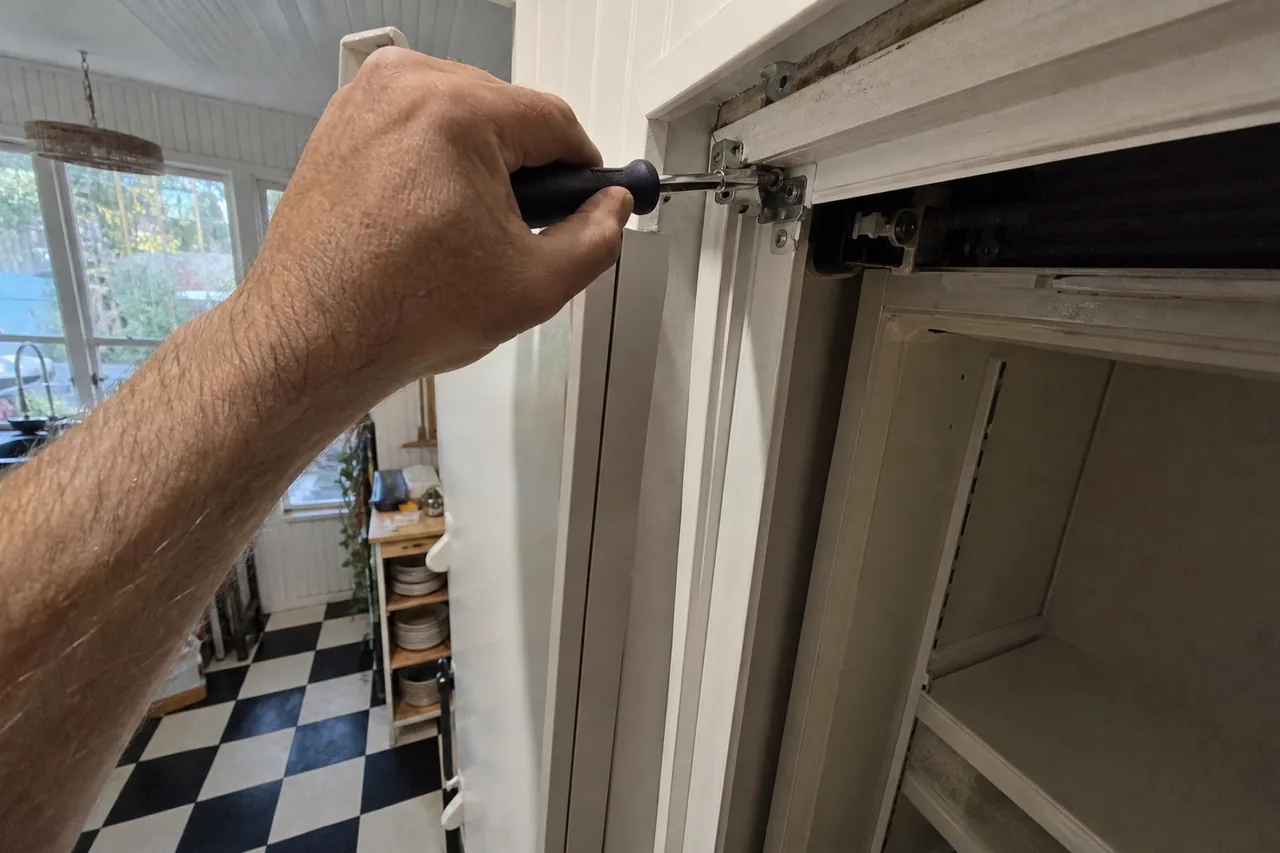
In a humid First Coast summer, a door that does not seal pulls damp air into the cabinet, and the frost that follows makes the fans and defrost system work harder. Panel-ready doors also carry the weight of a cabinet panel, so the hinges can let them drop slightly over the years. A small turn at the top hinge often brings the gasket back into full contact, but go slowly and take a photo first so you can return to where you started.
Sealed-system work is another matter on either brand. Plenty of today’s home refrigerators run on hydrocarbon refrigerants like R-600a or R-290. The safety standard UL 60335-2-24 (2017 edition, taken up by the EPA in 2018) caps the charge in each circuit at 150 grams, or 5.29 ounces. Those small, flammable charges call for the right tools and procedures, so leave them to a technician.
Warranty coverage after the first years
Both makers stand behind the sealed system (compressor, evaporator, condenser, drier and connecting tubing) well past the first year, and Thermador’s terms run a little longer. On a built-in Thermador refrigerator, parts and labor on that system continue from the 3rd through the 6th year, then parts alone from the 7th through the 12th year, plus lifetime parts-only coverage against stainless rust-through. Miele covers its sealed system, refrigerant included, with five years of parts and labor followed by another five years of parts only, when you pay the labor.
Before any claim, gather the identifiers. Thermador puts the E-Nr and FD numbers on a rating label you will find just inside the refrigerator, along its right wall near the opening. Take a picture of it the day the unit goes in and keep it with the receipt.
What ownership costs when something breaks
Showroom prices shift with dealers, panels and promotions, so this guide leaves them aside. Repair costs land in the same bands for both brands because the parts are alike. A visit starts with an $80 diagnostic. Replacing a door gasket or seal typically runs $230–$620, an evaporator or condenser fan motor $250–$580, and a defrost heater, thermostat or sensor $240–$640, with the firm figure given after diagnosis. A new built-in unit usually falls in the $8,600–$19,400 range, which is why a single failed part on either brand is normally worth fixing.
Choosing between them
Lean toward Thermador if you want a wall of mixed column widths, a chilled drawer set below the main compartment, or automatic door opening. Lean toward Miele if a published quiet rating matters, if the MasterFresh compartment suits the way you shop, or if the rest of the kitchen already follows Miele’s design. Either way, the installation matters as much as the name: a level cabinet, correct clearances and a properly adjusted door decide how well the column runs. Weighing other names too? Our Gaggenau vs Sub-Zero comparison works through the same questions.
If you already own either one and it is acting up, First Coast Appliance Group repairs both brands across the First Coast as an independent service, not manufacturer-authorized.