Brand — Thermador
Thermador Built-Ins on the First Coast
The widest product spread of any brand we cover — cooking, column refrigeration, dishwashers, steam and coffee, and ventilation, all under one name.
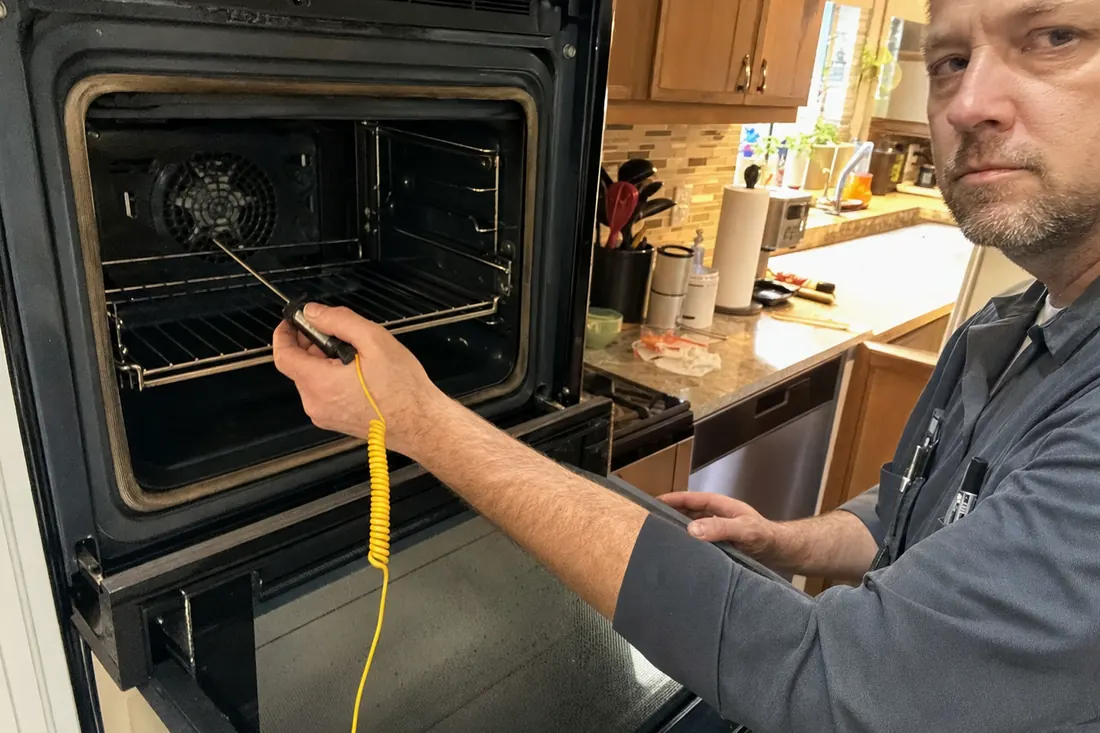
Thermador covers more of a kitchen than any other manufacturer on this site. A single Thermador specification can include the range or cooktop, the wall ovens, a steam oven, a built-in coffee system, refrigerator and freezer columns, the dishwasher and the hood. That breadth is convenient for the homeowner and it is the reason Thermador calls are the most varied ones we take.
Because the range is so wide, the regional conditions on the First Coast hit a Thermador kitchen from several directions at once.
Column refrigeration
Columns are single-purpose cabinets — refrigerator or freezer, not both — set flush into millwork and vented through a grille rather than through the back of the room. They are quieter and hold humidity better than a freestanding box, and they are far less tolerant of a blocked air path. When a column runs continuously and the cabinet stile beside it feels warm, we look at the condenser and its airflow before anything else.
Two columns installed side by side behind matching panels are two separate appliances, each with its own compressor, its own condenser, its own control and its own serial number. Owners reasonably describe them as one unit; the parts list does not. A fault on the freezer column says nothing about the refrigerator column beside it, and establishing which of the two is actually misbehaving is the first thing a call on a column pair sorts out.
Where a column feeds an ice maker or a dispenser, the water connection adds a timing mechanism rather than a measuring one — the fill valve is held open for a fixed number of seconds and nothing checks how much arrived — so shrinking cubes and a mold that fills at one end are fill-volume symptoms, not temperature ones.
Sealed-system work means handling refrigerant, which is federally regulated. Our technicians hold EPA Section 608 certification.
Cooking
Induction is the platform that generates the most calls. An element that works briefly and then cuts out under a heavy pan is usually a thermal protection event in the inverter electronics beneath the glass, not a failure of the element itself — which is why it comes back after it cools and then repeats. Gas rangetops fail more mechanically: ignition electrodes, burner caps sitting proud, and simmer settings that have drifted.
Wall ovens with a steam cavity and plumbed coffee systems bring the appliance’s own counters into the diagnosis. Both keep a service schedule set against an assumed average rather than a measurement of their own condition, so a prompt satisfied on time proves nothing about the heating circuit, and a prompt that returns immediately after being cleared means the accessible path was cleared and the rest was not. That is the point where the job stops being maintenance, and the generator or brew assembly behind it is a serial-number part with a lead time.
Dishwashers
Fully integrated dishwashers hide behind a cabinet panel, which changes the service work more than most people expect: the machine cannot move until the panel does, and in the pre-war kitchens of Riverside, Avondale and San Marco the panel is frequently attached to millwork that was fitted around the machine after installation. Then the trim comes off before the appliance does, and that goes on the estimate rather than being discovered on the day.
The washing complaints themselves run in a fixed order: filter, sump, spray-arm rotation and drain path before any pump is suspected. A drain hose without a high loop and a disposal knockout plug that was never removed both produce the standing water people attribute to a failed pump, and both cost nothing to rule out.
Ventilation
Downdrafts have more to go wrong than a wall hood because they move. A downdraft that rises slowly, stops part-way, or refuses to retract is usually a drive or sensor fault rather than a motor fault. Remote and inline blowers add roof or soffit runs, and on the coastal ZIPs those runs corrode from the outside.
Working on the First Coast
Around 68 thunderstorm days a year pass over this region, and a Thermador kitchen has more boards in it than most. When several appliances behave oddly in the same week, the common factor is often the supply, not the appliances — appliances do not coordinate.
Long outages leave a delayed signature on the same kitchens. Matthew in 2016, Irma in 2017 and Helene in 2024 each cut power for days across parts of the region, and the boards that failed afterwards mostly failed weeks later rather than during the event. Whole-house surge protection at the panel is the measure that changes those odds; it is electrician work rather than appliance work, and it is the recommendation we make most often on a specification this board-dense.
Parts follow the same rule as everywhere else: ordered against the serial number, not the model, because a Thermador kitchen bought as one package can still carry different revisions across its appliances.
We are an independent repair company. The Thermador name appears here only to identify the appliances we service.
Related guides
Guides that cover Thermador
| Guide | Topic | Read |
|---|---|---|
| What Salt Air Does to a Condenser Coil | Coastal & salt air | 7 min |
| Storm Season and Appliance Control Boards | Power & electronics | 6 min |
02 What it costs
What does a Thermador repair cost here?
$180 to $570 covers most of what we finish on this kind of fault — what the job has cost before, not a quote.
$80 Flat $80 diagnostic covering the visit and the full diagnostic sequence, credited toward the repair once you approve the work.
| Repair | Typical total |
|---|---|
| Igniter, spark module or surface element | $210–$530 |
| Oven thermostat or temperature sensor | $180–$570 |
03 Questions
What do owners ask before booking a Thermador visit?
- What does a Thermador repair cost on the First Coast?
- The diagnostic is $80 flat and comes off the total once you approve the work. Completed Thermador work in the First Coast has landed between $180 and $570, parts and labor together — here, igniter, spark module or surface element $210–$530, and oven thermostat or temperature sensor $180–$570. That is what the job has cost before, not a quote; the firm figure is written down after the diagnosis.
- Are you a Thermador service center?
- No. We are an independent repair company and hold no approval from Thermador or anybody else. The name is used here only to identify the equipment we work on: ranges, rangetops and induction cooktops, built-in wall ovens, steam ovens and coffee systems, column refrigerators and freezers.
- What goes wrong with Thermador equipment here most often?
- Induction element dropping out after a few minutes at high power heads the list, and the rest of what we see is set out above. Two regional conditions drive most of it: On the barrier islands, salt air is the corrosion driver: condenser fins, door hinges, fasteners and stainless trim go first. Around 68 thunderstorm days a year. Repeated line transients are what kill appliance control boards here, far more often than a single direct strike.
- What happens if the same fault comes back?
- 90 days on labor, 365 days on parts, and we fit genuine OEM parts rather than pattern equivalents. Both clocks run from the date of the repair, so a part that fails inside its term is replaced rather than re-quoted.
- Why does a part sometimes take a second visit?
- Parts for built-in and professional equipment are ordered against the serial number, not the model alone: the same model built two years apart does not always take the same component. Sealed-system parts, inverter boards and steam-generator assemblies are the ones that wait. Door hardware, gaskets, thermistors and fan motors usually do not.
Customer reviews
Thermador jobs customers wrote up afterwards
Drawn from the reviews filed against Thermador work. The rating beside them is the average of every review published on this site.
4.3out of 5 from 90 published reviews
Rated 3 out of 5
The downdraft rises properly again after a new lift motor. The work is solid, but nobody told me the part would take the best part of a fortnight and I only found out because I rang to ask where it was.
Horace B.
Rated 4 out of 5
The fridge column in our Eagle Harbor kitchen was icing along the back while the freezer column beside it was fine. He found an open heater circuit, replaced it, and checked the second column too so we would not be calling him back.
Nadine C.
Rated 4 out of 5
The steam oven left a chalky residue in the cavity after every cook. He descaled the boiler, replaced a valve that was weeping, and set the hardness so the cleaning routine actually matches our supply.
Verity O.