Appliance — Cooking
Range, Cooktop and Wall Oven Repair
Professional and dual-fuel ranges, gas rangetops, induction and radiant cooktops, single and double wall ovens, warming drawers.
01 Symptom index
What the symptom usually means
| Symptom | Usually looks like |
|---|---|
| Igniter keeps clicking after the burner has lit | Burner cap out of position, or an electrode the module cannot read a flame from |
| Oven not heating, though the display and the fan still work | On gas, an ignition circuit no longer opening the valve; on electric, a bake element or its relay never brought in |
| Oven burner takes several tries from cold but lights instantly when warm | Ignition circuit no longer drawing enough current to open the gas valve |
| Cavity runs consistently hot or cold against the setpoint | Sensor drift, a slowed convection fan, or a door no longer sealing at the top |
| Induction zone works for minutes then drops out under a heavy pan | Thermal protection in the inverter electronics under the glass |
| Display resets or the appliance will not start, then is fine next morning | Control board disturbed by supply transients rather than a hard failure |
| Uneven browning towards the back of the oven | Door out of square on its hinges, or a convection fan losing speed |
Cooking equipment fails differently from refrigeration. There is no sealed system, no compressor and nothing running continuously in the background. What drives cooking faults on the First Coast is heat cycling, mechanical load, the quality of the electrical supply, and — in a large part of the region — the age of the building the appliance was fitted into.
Gas: ignition is where most calls start
Two symptoms account for most gas complaints, and they are opposites.
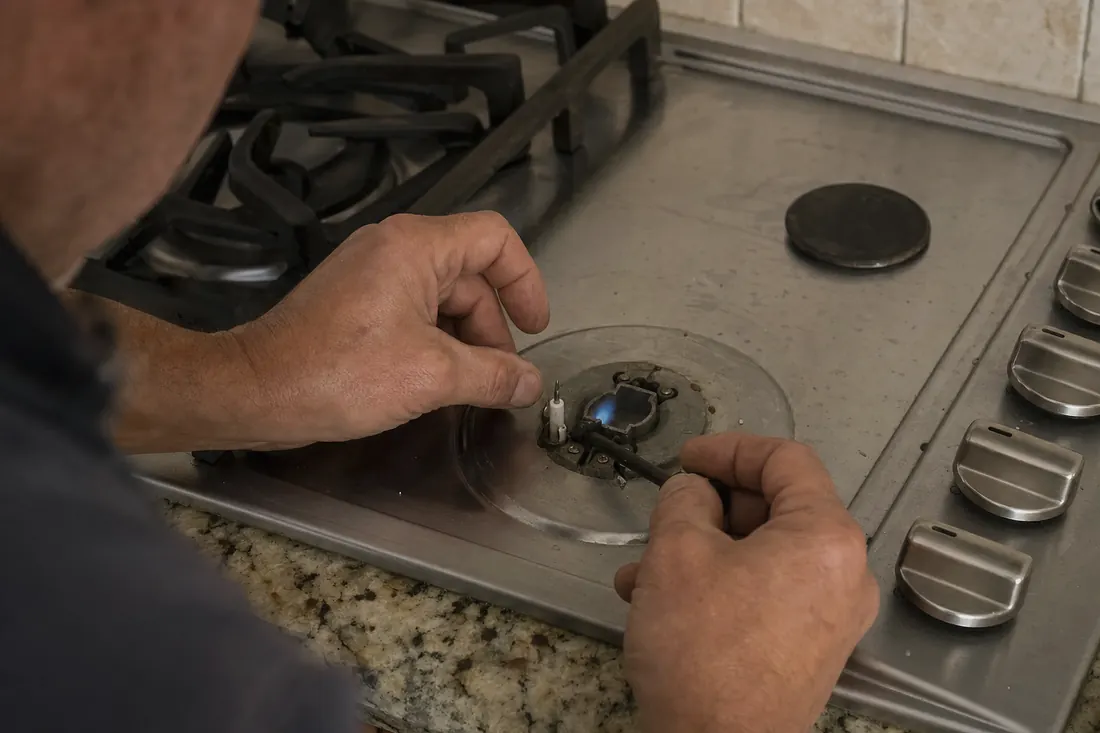
A surface burner that lights and then keeps clicking has a flame, but the spark module cannot confirm it. Nine times in ten the burner cap is a fraction out of seat, or the electrode is damp or fouled. Local humidity makes the second cause seasonal: an electrode near a sink in a Jacksonville kitchen in August is not in the same condition it was in February.
An oven burner that needs several attempts from cold, then lights immediately once the cavity is warm, is the other pattern. The igniter still glows, so it looks healthy, but it no longer draws enough current to hold the gas valve open until it has been preheated by its own residual warmth. That fault only gets worse, and it is one of the few where the component reliably tells the truth about itself.
Electric and induction
Radiant elements fail bluntly — they work or they do not. Induction is more interesting. The heating is done by electronics under the glass, and those electronics have to be kept cool. A zone that runs for several minutes at high power and then cuts out, only to work again once it has rested, is almost always thermal protection doing its job rather than a failed element. The real question is why the electronics are getting hot: a blocked cooling path, a fan that has slowed, or an installation with insufficient clearance beneath the counter.
That last one is common in retrofits. Induction was specified into a cabinet that was cut for a gas hob, and the drawer beneath it now blocks the air path.
The oven that is “twenty degrees off”
This is the single most common cooking complaint and it has at least four distinct causes: a temperature sensor that has drifted, a convection fan turning slower than it should, a door that no longer seals evenly because a hinge has taken a set, and a calibration that was wrong from the day of installation. We measure the cavity before we touch a calibration offset. Trimming the offset to mask a failing sensor hides the fault and makes the next visit harder.
Heavy professional doors deserve attention on their own. The hinge carries a lot of mass through a small arc, and once the door drops it stops loading the gasket evenly. The first evidence is usually a warm cabinet stile beside the oven, not a temperature reading.
What the First Coast adds
Storm season. Around 68 thunderstorm days a year cross this region. It is rarely a single strike that takes a cooking board out — it is repeated line transients across a summer. When a range loses its display in September after a faultless winter, that is the pattern we test for first. Long outages compound it: Matthew in 2016, Irma in 2017 and Helene in 2024 each left parts of the region dark for days, and the boards that failed afterwards mostly failed weeks later rather than during the event.
Pre-war kitchens. Riverside, Avondale, Old Ortega, San Marco and Old Mandarin are largely 1900s–1930s housing. Cabinet openings were framed to pre-war dimensions and the kitchens seldom have a dedicated 20-amp circuit, never mind the 240-volt supply an induction cooktop or a dual-fuel range wants. On those addresses the limiting factor on a repair or a swap is frequently the opening and the panel, not the appliance. We check both before quoting anything that involves pulling the unit out.
Coastal air. On 32082, 32250, 32266, 32233, 32084 and 32034, the visible parts go first — fasteners, hinge pins, trim and any outdoor cooking equipment. Internal components are usually fine long after the exterior has stopped looking it.
Parts, and what waits. Cooking components divide cleanly. Igniters, electrodes, burner caps, thermostats, convection motors, hinges and gaskets are ordinary parts. Inverter boards for induction, glass tops and cavity liners are ordered against the serial number and are the ones that hold a job up. We put the expected wait on the estimate rather than at the second visit.
02 Diagnostic order
What a technician checks, and in what order
Order matters more than tooling. Each step is cheaper, faster or likelier than the next, and has to be ruled out before it.
-
01
What the appliance is being asked to do
Dual-fuel, all-gas, induction and radiant platforms share almost nothing but a fascia. Establishing which half of a dual-fuel unit is misbehaving, or whether a fault is in the cavity or the cooktop, removes most of the possible causes before a panel comes off.
-
02
Supply — gas pressure or circuit
Ignition faults and elements that drop out both have a supply explanation as well as a component one, and the supply is faster to check. In pre-war kitchens the circuit is the more likely of the two, and it changes what can be fitted as well as what has failed.
-
03
Ignition circuit or inverter cooling
On gas, an oven burner that needs several attempts from cold and lights instantly when warm is a current-draw fault in the ignition circuit. On induction, an element that runs for minutes and then drops out is thermal protection in the electronics under the glass — the question is what is stopping them cooling.
-
04
Measure the cavity before touching calibration
An oven "twenty degrees off" can be a drifting sensor, a slowed convection fan, a door no longer sealing, or a calibration that was wrong from installation. Trimming the offset to mask a failing sensor hides the fault and makes the next visit harder.
-
05
Door, hinge and gasket geometry
A heavy professional door carries a lot of mass through a small arc. Once it takes a set it stops loading the gasket evenly, and the first evidence is a warm cabinet stile or uneven browning at the back of the cavity, not a temperature reading.
-
06
Control board, last
Boards do fail here, particularly after a season of transients or a long outage and restart. They are checked last because almost everything a failing board is blamed for has a cheaper explanation upstream of it.
Parts for built-in and professional equipment are ordered against the serial number, not the model alone: the same model built two years apart does not always take the same component. Sealed-system parts, inverter boards and steam-generator assemblies are the ones that wait. Door hardware, gaskets, thermistors and fan motors usually do not.
Built-in equipment is fitted to the millimetre. A refrigerator column comes forward on rails and carries several hundred pounds with the doors on; an integrated dishwasher cannot move until its cabinet panel does. Reaching the back of either is frequently the longest part of a visit, and it is priced in the written estimate before it starts.
04 What it costs
What does cooking repair cost here?
$180 to $570 covers most of what we finish on this kind of fault — what the job has cost before, not a quote.
$80 Flat $80 diagnostic covering the visit and the full diagnostic sequence, credited toward the repair once you approve the work.
| Repair | Typical total |
|---|---|
| Igniter, spark module or surface element | $210–$530 |
| Oven thermostat or temperature sensor | $180–$570 |
05 Questions
What gets asked about cooking?
- How much is cooking repair around Jacksonville?
- The diagnostic is $80 flat and comes off the total once you approve the work. Completed work on cooking has landed between $180 and $570, parts and labor together — here, igniter, spark module or surface element $210–$530, and oven thermostat or temperature sensor $180–$570. That is what the job has cost before, not a quote; the firm figure is written down after the diagnosis.
- Is it worth repairing or should it be replaced?
- The band above, weighed against a replacement: for built-in refrigeration a comparable unit is $8,600–$19,400 for the appliance alone, before delivery, fitting or panels. Short of a sealed-system failure on an old cabinet, the repair is usually the cheaper half of that arithmetic, and the written estimate lets you check it rather than take our word.
- Why do storms keep taking these out?
- Around 68 thunderstorm days a year. Repeated line transients are what kill appliance control boards here, far more often than a single direct strike.
- Does the appliance have to come out of the cabinetry?
- Sometimes, and the diagnostic covers finding out — some faults are reachable from the front and some are not. Where an appliance has to come out, the removal and the reinstatement are separate lines on the written estimate, agreed before anything moves.
- When do I find out what the repair will actually cost?
- Before anything is ordered. Written estimate before any work begins. Parts and labor are itemised separately, and if you decline it you have paid $80 for the visit, the diagnosis and an estimate that is yours to take anywhere.
Customer reviews
Cooking calls, described by the people who booked them
Reviews filed against cooking work. The rating averages every review published here.
4.3out of 5 from 90 published reviews
Rated 4 out of 5
The wall oven ran hot enough to ruin everything at the stated temperature. He calibrated it against a probe, replaced the sensor, and left me the before and after readings written down rather than just telling me.
Barnaby F.
Rated 5 out of 5
The range door had sagged under its own weight and the back of the oven was scorching everything. He rebuilt the hinges, replaced the gasket and reset the door square. Browning is even across the shelf now.
Cecily B.
Rated 5 out of 5
The griddle on the rangetop was hot at one end and cool at the other. He rebuilt a connection that had burnt at the element rather than selling me the whole assembly. Even heat right across the plate now.
Wanda E.