Brand — Wolf
Wolf Cooking Equipment on the First Coast
Cooking equipment only — ranges, rangetops, cooktops, wall ovens, steam and warming drawers, and pro ventilation. No Wolf refrigeration exists.
Wolf builds cooking equipment and nothing else. There is no Wolf refrigerator — in a kitchen specified around Wolf, the refrigeration is usually Sub-Zero and the dishwasher is usually Cove. That distinction matters when you book. A “Wolf kitchen” call can involve three different machines built on three different lines, and knowing which one is actually misbehaving changes what a technician brings to the door.
Ranges, rangetops and cooktops
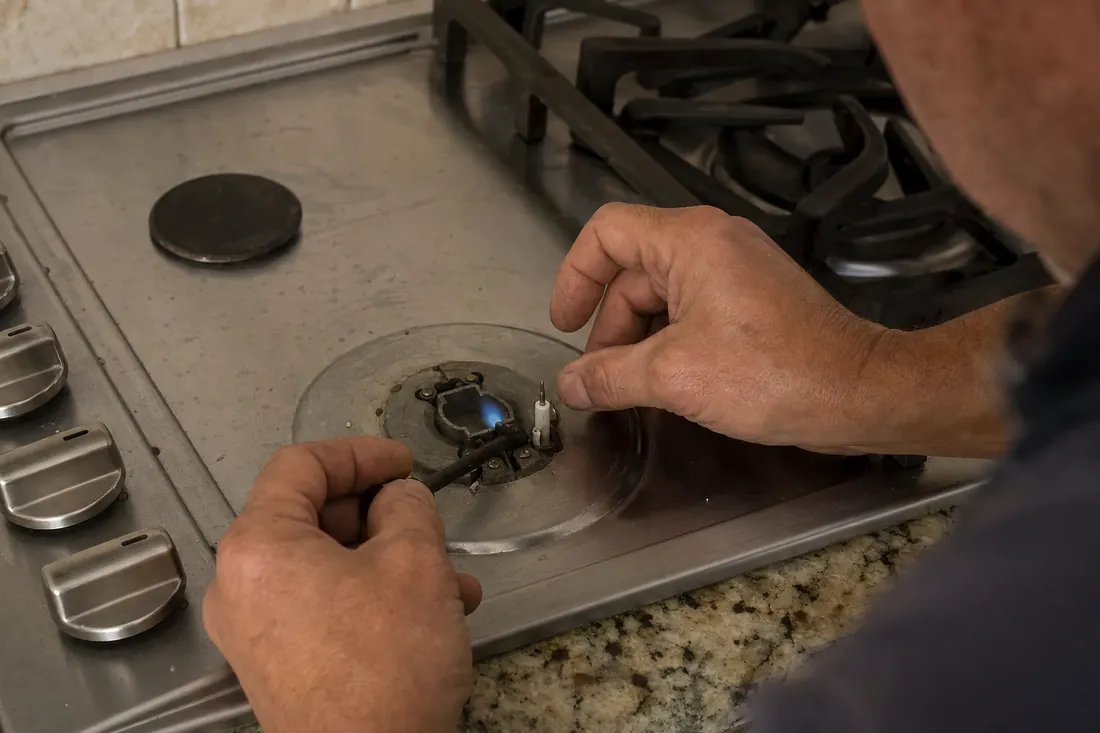
The gas cooking platform is the one we see most. A surface burner that lights and then keeps clicking is almost never a gas-supply problem; it is the spark system continuing to fire because the module is not seeing a flame, and the usual cause is a burner cap sitting a fraction out of position or an electrode that has picked up moisture. On the First Coast that second cause is seasonal. Summer humidity here is high enough that an electrode in a kitchen with a window over the sink can behave differently in August than it did in February.
Dual-fuel units put a gas top over an electric oven, so a fault on one half tells you very little about the other. Induction cooktops move the problem somewhere else again: the fault is usually thermal, in the inverter electronics under the glass, and it presents as an element that works for ten minutes and then drops out under a heavy pan.
Ovens and the temperature complaint
“The oven is off by twenty degrees” is a symptom, not a diagnosis. It can be a drifting temperature sensor, a convection fan that has slowed, a door that no longer seals at the top corners because the hinges have taken a set, or a calibration that was never right after an install. We measure the cavity before touching a calibration setting, because adjusting the offset to mask a failing sensor makes the next fault harder to find, not easier.
Heavy pro-style oven doors are worth watching in older installations. The hinge carries a lot of mass through a small arc, and once it starts to sag the door stops loading the gasket evenly. You feel it as a warm patch on the cabinet stile before you see it on a thermometer.
What the region does to cooking equipment
Three local conditions shape this work.
Line transients. Around 68 thunderstorm days a year pass over the First Coast. The damage is rarely a single dramatic strike — it is the accumulated effect of repeated transients on control boards. A range that has run fine for years and then loses its display or its relay control in late summer fits a pattern we see every season, and long outages produce a delayed version of it: Matthew in 2016, Irma in 2017 and Helene in 2024 each cut power for days across parts of the region, and most of the boards that failed afterwards failed weeks later rather than during the event.
Salt air. On the barrier-island ZIPs — Ponte Vedra Beach 32082, Jacksonville Beach 32250, Neptune Beach 32266, Atlantic Beach 32233, coastal St. Augustine 32084 and Amelia Island 32034 — stainless trim, fasteners, hinge pins and hood hardware corrode from the outside in. Outdoor cooking equipment on those addresses lives a much shorter life than the same equipment three miles inland.
Pre-war kitchens. In Riverside, Avondale, Old Ortega, San Marco and Old Mandarin, the constraint on a range replacement or repair is frequently the building rather than the appliance. Those kitchens were framed to 1900s–1930s dimensions, and they rarely have a dedicated 20-amp circuit, let alone the 240-volt supply a dual-fuel or induction platform expects. We check the opening and the panel before we quote anything that involves removing the unit.
Steam ovens
Wolf’s convection steam ovens take water from a reservoir or a plumbed line, and the two arrangements fail in different places. A plumbed unit has a shutoff, a line, a connection and often a filter housing in front of it, and any one of those can present at the control panel as a fault on the appliance — the supply to the machine is established as good before the machine is suspected. A reservoir unit moves the problem inside the cabinet: the tank seal, the pickup and the valve that closes after fill are the recurring items, and a reservoir emptying faster than the cycles used it is a leak rather than a control fault.
Beyond that, these appliances count rather than measure. The service prompt is a schedule set against an assumed average, not a report on the state of the heating circuit, so satisfying it on time proves nothing, and a prompt that returns immediately after being cleared means the accessible path was cleared and the rest was not. Time-to-steam is the more honest number: an element working through anything that insulates it runs longer for the same output, and that stretch appears well before a fault does.
Parts and access
Wolf cooking parts divide cleanly. Igniters, electrodes, burner caps, grates, thermostats, convection motors, hinges and gaskets are ordinary stock items. Inverter boards for induction, glass tops, cavity liners and steam-generator assemblies are ordered against the serial number and are the ones that hold a job up, because the same model built two years apart does not always take the same component. The expected wait goes on the written estimate rather than arriving as news at a second visit.
Access matters most on wall ovens and on ranges heavy enough to need two people and a plan. Where a unit has to come out of a stack, or forward out of a run, to reach the fault, the removal and the reinstatement are quoted before anything moves.
We are an independent repair company. We use the Wolf name here only to identify the appliances we work on.
Related guides
Guides that cover Wolf
| Guide | Topic | Read |
|---|---|---|
| Storm Season and Appliance Control Boards | Power & electronics | 6 min |
| Fitting Built-Ins Into Pre-War First Coast Kitchens | Fitting & replacement | 7 min |
02 What it costs
What does a Wolf repair cost here?
$180 to $720 covers most of what we finish on this kind of fault — what the job has cost before, not a quote.
$80 Flat $80 diagnostic covering the visit and the full diagnostic sequence, credited toward the repair once you approve the work.
| Repair | Typical total |
|---|---|
| Oven thermostat or temperature sensor | $180–$570 |
| Igniter, spark module or surface element | $210–$530 |
| Convection fan or motor | $260–$720 |
03 Questions
What do owners ask before booking a Wolf visit?
- What does a Wolf repair cost on the First Coast?
- The diagnostic is $80 flat and comes off the total once you approve the work. Completed Wolf work in the First Coast has landed between $180 and $720, parts and labor together — here, oven thermostat or temperature sensor $180–$570, and igniter, spark module or surface element $210–$530. That is what the job has cost before, not a quote; the firm figure is written down after the diagnosis.
- Are you a Wolf service center?
- No. We are an independent repair company and hold no approval from Wolf or anybody else. The name is used here only to identify the equipment we work on: dual-fuel and gas ranges, rangetops and cooktops, built-in wall ovens.
- What goes wrong with Wolf equipment here most often?
- Surface burner clicking continuously after it has lit heads the list, and the rest of what we see is set out above. Two regional conditions drive most of it: On the barrier islands, salt air is the corrosion driver: condenser fins, door hinges, fasteners and stainless trim go first. Around 68 thunderstorm days a year. Repeated line transients are what kill appliance control boards here, far more often than a single direct strike.
- What happens if the same fault comes back?
- 90 days on labor, 365 days on parts, and we fit genuine OEM parts rather than pattern equivalents. Both clocks run from the date of the repair, so a part that fails inside its term is replaced rather than re-quoted.
- Why does a part sometimes take a second visit?
- Parts for built-in and professional equipment are ordered against the serial number, not the model alone: the same model built two years apart does not always take the same component. Sealed-system parts, inverter boards and steam-generator assemblies are the ones that wait. Door hardware, gaskets, thermistors and fan motors usually do not.
Customer reviews
Wolf jobs customers wrote up afterwards
Drawn from the reviews filed against Wolf work. The rating beside them is the average of every review published on this site.
4.3out of 5 from 90 published reviews
Rated 4 out of 5
The hood blower rattled at low speed and was fine flat out, which turned out to be a worn bearing. He fitted a new motor, balanced the wheel and cleaned years of grease out of the housing while it was down.
Ambrose K.
Rated 5 out of 5
A surface burner clicked on and on after it had lit. He dried the electrode and reseated the cap, and when it did it again he showed me the module that was not seeing flame. Replaced it and the clicking stopped for good.
Cordelia B.
Rated 4 out of 5
The oven door was not shutting flush at the top corners and the kitchen got hot whenever it was on. He replaced the hinges and the door seal, then set the door square. The heat stays where it belongs now.
Harriet N.